


On January 15, 2009, US Airways Flight 1549 took off from New York’s LaGuardia Airport.
Less than two minutes later, the aircraft struck a flock of birds.
Both engines lost thrust.
The aircraft was suddenly without normal engine power, with 155 people on board.
Captain Chesley “Sully” Sullenberger declared an emergency.
But the most important part of the story was not simply what happened next.
It was how the people inside the cockpit responded when their normal operating environment disappeared.


WHEN THE NORMAL SYSTEM DISAPPEARS
In a crisis, people do not automatically become better decision-makers.
Under extreme pressure, attention narrows. Communication can become fragmented. People can become reactive. The brain begins prioritizing immediate survival.
Yet inside Flight 1549, something different happened.
The cockpit became intensely focused.
Communication became short and direct.
The crew concentrated on the immediate problem rather than allowing the situation to overwhelm their ability to act.
This distinction matters far beyond aviation.
Because leadership is often tested not when everything is working—but when the system suddenly stops working.


THE DECISION: HUDSON OR AIRPORT?
Sullenberger initially considered returning to an airport.
But the available options were changing by the second.
The Hudson River became the viable option.
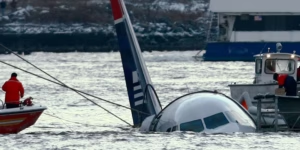
The decision was made to ditch the aircraft in the river.
Later simulator testing supported that decision.
Investigators found that returning to an airport was not realistically achievable once the time required for decision-making and attempted engine restart was taken into account.
The Hudson was the option that gave the aircraft a viable path to survival.
This is an important distinction in leadership:
A crisis is not the time to search for a perfect option.
It is the time to identify the option that remains viable—and execute it.


SURVIVOR ENERGY VS. LIFE ENERGY
This is where the Hudson River story connects directly to the Max Energy framework.
Max Energy distinguishes between two broad operating states:
Survivor Energy is dominated by threat, fear, reactivity and narrowed attention.
Life Energy is the state in which people can access clearer thinking, evaluate options and execute purposeful action.
The objective is not to eliminate pressure.
The objective is to remain capable of thinking and acting despite pressure.
Flight 1549 was an extreme example.
The aircraft had lost both engines.
Time was disappearing.
There was no comfortable solution.
Yet the crew continued to perform their roles.
That is the critical point.
The aircraft lost engine power. The crew maintained control of the aircraft and their responsibilities.

ROLE CLARITY UNDER PRESSURE
First Officer Jeffrey Skiles immediately worked through the appropriate checklist while Sullenberger focused on flying the aircraft.
The investigation later concluded that both pilots acted professionally and maintained their respective responsibilities.
This is one of the most overlooked elements of high-performance leadership.
In a crisis, people need to know:
Who is doing what?
When roles become unclear, cognitive energy is wasted.
When responsibilities are clear, people can direct their limited attention toward execution.
High-performance teams do not necessarily communicate more during a crisis.
They communicate better.


TRAINING DOES THE THINKING BEFORE THE CRISIS
One of the strongest lessons from Flight 1549 is that the successful landing was not created in the few minutes above the Hudson.
It was built through years of training, experience, procedures and preparation.
The crew did not suddenly acquire the ability to operate under pressure.
They had developed it before the crisis.
The investigation emphasized the combination of crew training and skill, aircraft design and favorable circumstances in producing the outcome.
This principle applies directly to business.
You cannot build crisis capability after the crisis begins.
A company’s ability to make decisions under pressure is largely determined by what it has built beforehand:
- leadership clarity,
- communication systems,
- role definition,
- training,
- decision protocols,
- trust,
- and the ability to regulate attention under pressure.


THE SMALL DECISION THAT MATTERED
One particularly important decision occurred early in the emergency.
Sullenberger started the Auxiliary Power Unit (APU).
That action helped preserve electrical power and important aircraft systems, including flight-envelope protections.
It was a seemingly small action that helped preserve the aircraft’s operational capability.
Leadership often works the same way.
Under pressure, people tend to focus exclusively on the largest visible problem.
But high-performance leaders also protect the systems that allow the organization to continue functioning.
Don’t only manage the crisis. Protect the system that must survive the crisis.


THE REAL LESSON IS NOT HEROISM
The Hudson River landing is often remembered as a story about extraordinary individual courage.
But the investigation provides a broader lesson.
It was not one person acting alone.
It was a trained crew.
Clear responsibilities.
Coordinated action.
A capable aircraft.
Appropriate procedures.
Experience.
And favorable conditions coming together at a critical moment.
The final lesson from the investigation was that teamwork and preparation enabled the crew to accomplish what was required.
That changes the leadership question.
Instead of asking:
“Who will save the company when the crisis comes?”
Leaders should ask:
“What kind of system will allow people to perform when the crisis comes?”


THE HUDSON PRINCIPLE
Every organization eventually faces its own version of a bird strike.
A sudden market collapse.
A cyberattack.
The loss of a major customer.
A critical executive departure.
A regulatory shock.
A failed product.
A liquidity crisis.
A technological disruption.
The specific event changes.
The human response does not.
When pressure rises, the quality of decision-making depends partly on the state in which people are operating.
This is where the Hudson River story connects with the Max Energy framework:
Energy State → Potential → Action → Result.
The state comes first.
Because the same person can have the same intelligence, experience and strategy—and produce completely different actions depending on their state.


STRATEGY DOESN’T EXECUTE ITSELF
Businesses often invest enormous resources in strategy.
Market analysis.
Financial models.
Technology.
Consultants.
Transformation programs.
But strategy exists only on paper until people execute it.
And people execute strategy through their attention, decisions, communication and behavior.
That creates a fundamental leadership question:
What state are your people in when they need to execute your strategy?
The Hudson River landing offers a powerful answer.
The crew could not control the bird strike.
They could not restore the engines.
They could not eliminate the pressure.
But they could control how they responded to the situation.
They maintained roles.
They communicated.
They evaluated the viable option.
They followed procedures.
They executed.
And 155 people survived.


THE MAX ENERGY LEADERSHIP LESSON
The deepest lesson of Flight 1549 is not simply that a great decision was made.
It is that a team remained capable of making decisions when almost everything around it had become uncertain.
That is what leadership under pressure ultimately requires.
Not the absence of fear.
Not the absence of uncertainty.
Not a perfect strategy.
But the capacity to maintain clarity, coordination and execution when the environment is changing faster than the plan.
The aircraft lost thrust from both engines. The crew maintained the clarity and coordination needed to act.
That may be the real leadership lesson from the Hudson.
When crisis comes, don’t try to create heroes.
Build a system capable of performing before the crisis ever arrives.
Because strategy doesn’t fail first.
The state in which people try to execute it may.
Because even the strongest strategy depends on people’s ability to think, decide and execute under pressure.
.
The Two Energies That Control Every Decision You Make Under Pressure


