


Three leadership signals from Davos 2026:
- AI is systemic, not incremental: It will reshape jobs, productivity, and power structures simultaneously.
- Geopolitics is now local: Global strategy must survive domestic pressure.
- Human judgment is the new moat: Trust, clarity, and decision quality matter more than prediction.
Davos 2026 wasn’t about the future.
It was about who is ready to lead now.
.


.
Davos 2026 was not about optimism or crisis alone.
It was about decision-making in a world where uncertainty has become the default condition.
Across technology, geopolitics, trade, AI, energy, and human development, one theme dominated conversations:
the old operating models no longer hold.
From CEOs and heads of state to scientists and cultural leaders, Davos revealed how global leadership is being redefined — not by vision statements, but by the ability to act under simultaneous disruption.


AI, Humanity, and the Future of Abundance
Session: Elon Musk on space, robots, energy and optimism
In a wide-ranging conversation with Larry Fink, Elon Musk framed AI, robotics, space, and energy as part of a single engineering problem.
“If that’s the case, then we need to do everything possible to ensure that the light of consciousness is not extinguished… we’re a tiny candle in a vast darkness.”
Musk argued for:
-
A multiplanetary future to preserve consciousness
-
Full re-usability in space technology to reduce costs by 100x
-
A world where humanoid robotics advances quickly and “everyone will have a robot”
-
An AI-driven abundance economy, potentially reversing ageing and eliminating poverty
On AI, Musk stated plainly:
“By 2030, AI will be smarter than all of humanity collectively.”
His closing note was not technical but psychological:
“It’s better for your quality of life to be an optimist and wrong than a pessimist and right.”


Vulnerability as Strength
Session: Music and Conversation with Yo-Yo Ma
In a session blending music, leadership, and human values, Yo-Yo Ma joined Christine Lagarde, Bryan Stevenson, and Aulani Wilhelm in a deeply personal discussion about crisis, tolerance, and humanity.
“You are not just showing us your emotions, you are showing us your strength.”
The message resonated strongly with younger leaders in the audience, particularly members of the Global Shapers Community, underscoring a Davos 2026 reality:
emotional intelligence is no longer soft power — it is leadership power.


Vision 2030 and Governing in Permanent Uncertainty
Session: Lessons from Saudi Arabia’s Vision 2030
As Saudi Arabia enters the final phase of Vision 2030, leaders emphasized long-term discipline in a fragmented world.
“In a fragmented world, one way to maintain trade is to become a stronger economy.”
— Faisal Alibrahim, Minister of Economy and Planning
Noubar Afeyan described the post-COVID era as a “pandemic of chaos,” while adding:
“Uncertainty opens up opportunity.”
The consensus:
absolute uncertainty is now the norm, and the role of policymakers is not to predict the future, but to create predictable environments within it.

Growth, AI, and the Employment Shock
Session: Want Growth? Prepare for Dilemmas
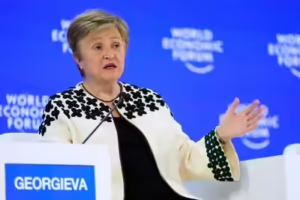
IMF Managing Director Kristalina Georgieva delivered one of the starkest assessments of the week:
“40% of jobs globally are going to be impacted by AI… In advanced economies, the figure is 60%.”
When asked if the world is ready, her answer was direct:
“No.”
The private sector’s adaptability has kept growth resilient — but Davos made clear that AI-driven productivity gains will come with massive human transitions.
.


Click Here
.


Geopolitics Is Now Local
Session: All geopolitics is local. What does it mean?
Foreign ministers and global investors agreed that globalization is being replaced by a more fragmented, competitive model.
“The world is transforming from a globalization macro framework to a different one.”
— Nir Bar Dea, CEO, Bridgewater Associates
The central tension:
how leaders balance domestic pressure with global cooperation in technology, security, and supply chains.


NYBEX Insight
Davos 2026 revealed a hard truth:
leadership today is no longer about having the right answers.
It is about making irreversible decisions
while the rules, systems, and assumptions are still shifting.
AI, geopolitics, climate, trade, and human development are converging — and executives who cannot operate across these dimensions simultaneously will fall behind.


Why This Matters for the Global Business Community
Davos 2026 will be remembered not for declarations, but for clarity:
-
Uncertainty is permanent
-
AI is systemic, not incremental
-
Human trust, resilience, and judgment are the new strategic assets
For leaders, the question is no longer what will change —
but how fast they can redesign their thinking, organizations, and decision frameworks.
NYBEX Editorial Note
This Davos coverage positions New York Business Excellence not as a news relay, but as a global leadership intelligence platform — translating world-stage conversations into executive insight.


