

The signals are clear. The pattern is not.
In the span of days, five seismic events reshaped the global business landscape:
Iran began laying mines in the Strait of Hormuz — placing 21% of global oil trade at immediate risk. Volkswagen announced the elimination of 50,000 jobs as Porsche profits collapsed by 98%. The US Treasury executed its largest single-day debt buyback in history — $15 billion. Russia ordered the exploration of a complete energy cutoff to Europe. Five major airlines — British Airways, Lufthansa, KLM, Air France, and Singapore Airlines — suspended Gulf routes.
Most CEOs are watching these events unfold through dashboards, analyst briefings, and breaking news alerts.
What they are not watching is themselves.


The Invisible Threat
“These are not isolated events. This is a pattern,” says Matthew Mustafa Gul, founder of the Max Energy System and leadership strategist with over 20 years of experience across many countries. “And every one of these events will trigger Survivor Energy in leadership teams — whether they are ready or not.”
Gul’s framework, built on Nobel Prize-winning research by Daniel Kahneman, Harvard Business School professor Amy Edmondson’s psychological safety model, and Korn Ferry Hay Group’s analysis of leaders, identifies two distinct leadership states that determine decision quality under pressure.
.


.
Survivor Energy — the reactive, fear-driven state triggered by uncertainty and threat — causes leaders to make short-term decisions that destroy long-term value. Teams operating under Survivor Energy leadership hide bad news, avoid conflict, and wait for direction rather than driving initiative.
Life Energy — the command state characterized by clarity, strategic thinking, and psychological safety — allows leaders to see opportunity where others see only threat.
“McKinsey research found that ineffective decision-making costs Fortune 500 companies $250 million per year,” Gul notes. “The root cause is rarely strategy. It is almost always energy state.”
Two Leaders. Same Crisis. Different Outcomes.
History has documented this pattern with precision — twice.


On March 17, 2000, a fire broke out at a Royal Philips Electronics semiconductor plant in New Mexico. Nokia and Ericsson both depended on that plant for 40 percent of their chip supply. Both companies received the same call on the same day.
At Nokia, the crisis reached senior leadership within hours. A response plan was activated immediately. Nokia secured alternative chip sources across multiple suppliers and lost zero production. At Ericsson, the technician who received the call did not notify his supervisors until early April. By then, Nokia had locked up the available supply. Ericsson was forced to exit independent mobile phone production entirely.
Same fire. Same chips. Same phone call. Entirely different leadership response.
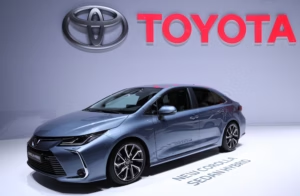

A decade later, the 2011 Great East Japan Earthquake delivered the same lesson at global scale. After the disaster severed Toyota’s supply chains, Toyota built a business continuity plan requiring suppliers to stockpile two to six months of semiconductors. When the 2021 global chip shortage forced Volkswagen, General Motors, Ford, Honda, and Stellantis to slow or suspend production, Toyota raised its vehicle output and increased its full-year earnings forecast by 54 percent.
“Toyota was, as far as we can tell, the only automaker properly equipped to deal with chip shortages,” said a person familiar with Harman International, as reported by Reuters.
“The difference was never strategy,” says Matthew Mustafa Gul, founder of the Max Energy System. “Ericsson had strategy. GM had strategy. Ford had strategy. What collapsed under pressure was their energy state. Survivor Energy doesn’t announce itself. It arrives disguised as urgency — and it makes decisions for you.”


The Window Is Now
Gul, who works with senior leaders across the United States and Europe, warns that the current convergence of geopolitical, financial, and energy disruptions represents a rare stress-test moment for leadership teams globally.
“The leaders who win in this environment will not be the best strategists,” he says. “They will be the ones operating from Life Energy — when everyone else collapses into Survivor Mode. The window to prepare is now. Not when the crisis hits your door.”
The Max Energy System offers leadership programs for CEOs, General Managers, and senior executives — designed to install the frameworks, habits, and awareness systems that maintain decision quality under extreme pressure.
About Matthew Mustafa Gul Matthew Mustafa Gul is the founder of the Max Energy System, a leadership performance methodology developed from Harvard Business School case analyses, Nobel Prize-winning behavioral research, and two decades of work with senior leaders across many countries. He is a member of the Harvard Business School Association of Boston.
For program information: www.TheMaxEnergy.com
.


Click Here
.


For leaders who want to go deeper into decision quality under pressure

Sources:
Walker, Russell & Wilson, Joanna. “Nokia’s Supply Chain Management.” Kellogg School of Management, Case KEL673, 2012. kellogg.northwestern.edu
Shirouzu, Norihiko. “How Toyota Thrives When the Chips Are Down.” Reuters, March 9, 2021. reuters.com)


