


A Strategic Shift Toward AGI and Enterprise AI
Why abandoning one of the most hyped AI products signals a deeper transformation in the AI power landscape
A Sudden Move That Shocked the Market
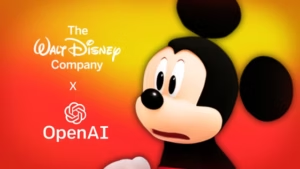
OpenAI has abruptly shut down its AI video tool Sora, ending a high-profile $1 billion partnership with The Walt Disney Company, according to reporting by Reuters, BBC, and The Guardian.
The decision came with little warning.
Just 30 minutes after a meeting between OpenAI and Disney teams, Disney executives were informed the project was being dropped — described by insiders as a “big rug-pull.” (Reuters)
The deal, which included Disney investing $1 billion and licensing over 200 characters for AI-generated video content, was never finalized and no funds were exchanged.


Why OpenAI Walked Away From Sora
At first glance, the move appears counterintuitive.
Sora was one of the most groundbreaking AI launches of 2024, capable of generating cinematic-quality video from text prompts.
But internally, the economics told a different story:
- AI video generation required massive computational resources
- It diverted capacity from higher-margin products
- It slowed progress in more strategic areas
According to Reuters, OpenAI leadership had been debating Sora’s future for months.
.


.


The Real Strategy: Focus on What Scales
This is not a retreat.
It is a strategic reallocation of power.
OpenAI is now doubling down on:
- Enterprise AI solutions
- Coding tools
- Robotics
- Artificial General Intelligence (AGI)
CEO Sam Altman is restructuring the company toward a unified AI super-app ecosystem, consolidating capabilities into a single platform.
At the same time:
- Leadership roles are shifting toward AGI deployment
- Safety teams are being reorganized
- Resources are being redirected to scalable AI infrastructure


The Hidden Signal: AI Is Moving From Content to Capability
Sora represented content creation AI.
OpenAI is now prioritizing decision-making and execution AI.
This reflects a broader shift in the industry:
- From generating media
- To powering real-world systems
As Altman’s team focuses on robotics and enterprise AI, the signal is clear:
The next phase of AI is not about what AI can create.
It’s about what AI can do.

Competitive Pressure Is Accelerating the Shift
The decision also comes amid rising competition.
Anthropic has gained traction with developer-focused tools like Claude Code, positioning itself strongly in enterprise AI.
Meanwhile, major players are racing to dominate:
- AI infrastructure
- developer ecosystems
- enterprise integrations
OpenAI’s pivot suggests a recognition that:
The highest-value battleground is no longer content — it’s computation and capability

What This Means for Media, Tech, and Leadership
For media companies like Disney:
- AI partnerships are becoming more volatile
- Long-term bets require flexibility
- IP strategy must evolve alongside AI capabilities
For business leaders:
This is the real takeaway:
- Even the most hyped innovation can be abandoned overnight
- If it does not align with long-term strategic leverage
Max Energy Insight: Strategy Is Not Commitment — It Is Adaptation
This decision reflects a core leadership principle:
Strategy is not about what you build.
It’s about what you are willing to stop.
Under pressure, most organizations:
- Hold on too long
- Protect sunk costs
- delay hard decisions
OpenAI did the opposite.
One Critical Question for Leaders
What are you still investing in that no longer serves your future strategy?
The Bottom Line
OpenAI’s shutdown of Sora is not a failure.
It is a signal.
- AI is consolidating
- Resources are concentrating
- The winners will be those who control infrastructure, not outputs
In the AI era:
The advantage does not belong to the company that builds more.
It belongs to the one that reallocates faster.


For leaders who want to go deeper into decision quality under pressure


