

The Case Behind the Headlines
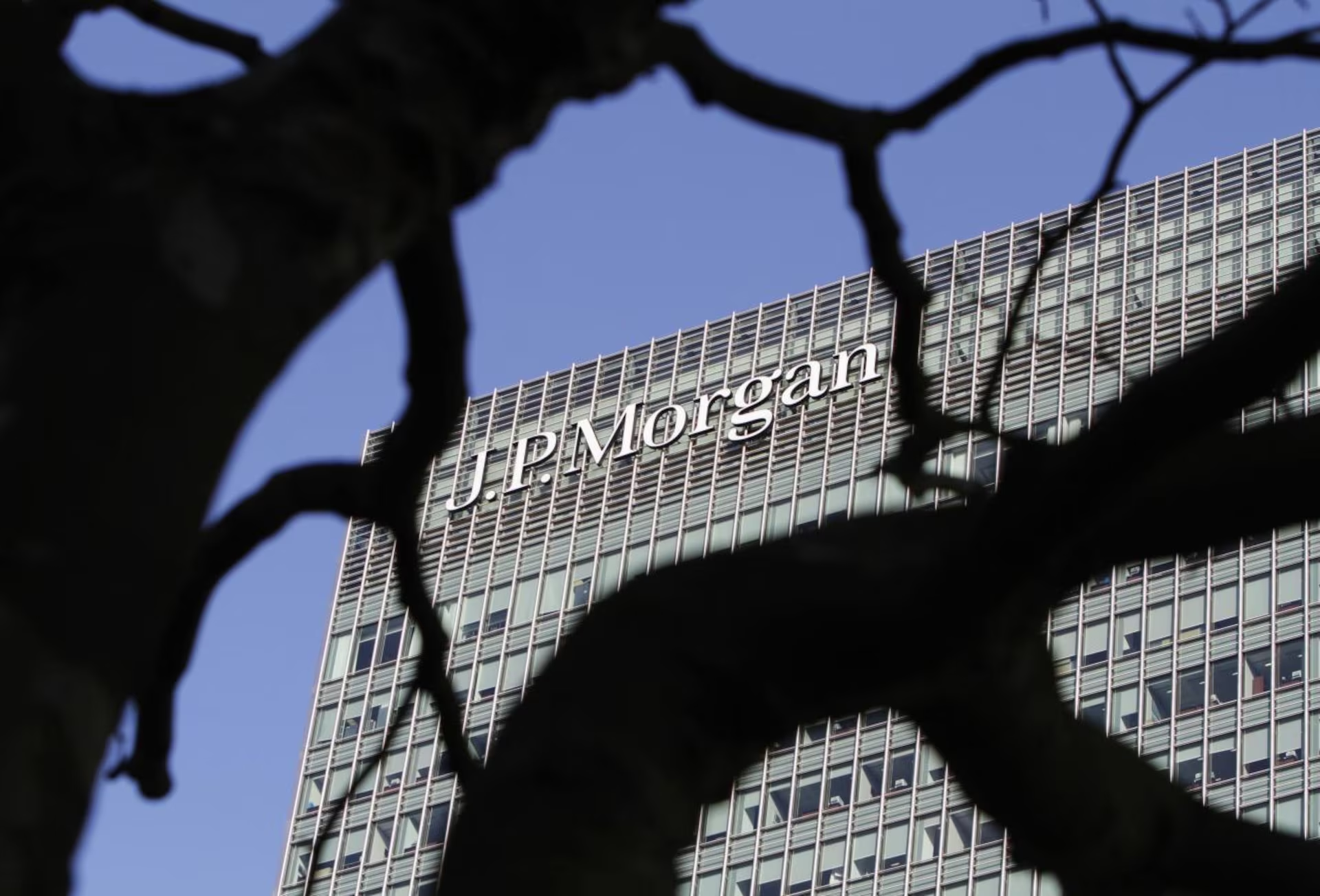
A recent lawsuit involving JPMorgan Chase has ignited intense debate around workplace power, accountability, and truth.
According to The New York Post, a former employee, publicly identified as Chirayu Rana, filed a lawsuit under a pseudonym, accusing colleague Lorna Hajdini of severe misconduct, including coercion and abuse of power.
Hajdini has categorically denied all allegations.
Following an internal investigation, the bank stated that it found no evidence supporting the claims, noting that the complainant did not fully participate in the process.
The case remains unresolved in court, with no trial date set.
.


.
The Critical Question
How should leaders navigate the line between allegation and truth?
In an era where reputations can be built—or destroyed—at digital speed, this question is no longer theoretical. It is operational.


Leadership Insight
1. Power Dynamics Are Never Neutral
Even when formal reporting lines suggest equality, perceived power can shape behavior, interpretation, and escalation. Leaders must recognize that power is not defined by hierarchy alone—but by influence, access, and perception.


2. Organizational Justice Is a System, Not a Statement
Most companies claim to uphold fairness. Few have systems that withstand high-stakes accusations.
A credible system requires:
- Transparent investigation protocols
- Independent review mechanisms
- Protection for both the accuser and the accused
Without this, organizations risk failing both truth and trust simultaneously.

3. Reputation Risk Is Now Real-Time
In today’s environment, legal outcomes are often slower than public judgment.
This creates a dangerous gap:
- Allegations spread instantly
- Facts emerge slowly
Leaders must learn to operate in this gap—balancing speed, fairness, and communication discipline.


4. False Allegation vs. Real Abuse: A Leadership Blind Spot
Organizations are often designed to respond to one scenario—not both.
- Overcorrect → risk of reputational damage from false claims
- Underreact → risk of enabling real abuse
The real challenge is not choosing a side—
It is designing systems that can handle both with integrity.


Leadership Task
How reliable and trusted is your company’s anonymous reporting system?
- Would employees trust it in a high-stakes situation?
- Is the process transparent—or opaque?
- Can it protect both whistleblowers and the wrongly accused?
This is not just a legal case.
It is a leadership stress test.
Because in modern organizations,
truth is not enough—systems must be built to protect it.


