



Lessons from Harvard Kennedy School on Influence, Voice, and Leadership in the Social Impact Economy
By Matthew Mustafa GUL | Global Leadership
How Global Leaders Build Influence Beyond Expertise
— Insights from Harvard’s frontlines of leadership development
Executive Presence Is No Longer Optional
— Why influence now depends on how leaders show up
Executive presence is no longer a “soft skill.”
It’s a leadership multiplier.
In today’s global leadership landscape, expertise alone doesn’t scale influence.
Presence does.
I published a new Global Leadership insight inspired by a powerful, experience-based session at Harvard Kennedy School, led by Lily Lapenna.
The core lesson was clear:
- It’s not what you say that builds trust.
- It’s how you deliver it.
In high-stakes environments — social innovation, public leadership, executive decision-making — leaders are judged less by credentials and more by clarity, presence, and narrative power.
This is why executive presence is no longer optional.
It’s how leadership travels, convinces, and scales.
Key question for leaders accelerating their careers:
If your expertise is strong — but your presence is weak —
how fast can your leadership really grow?
In today’s leadership landscape, expertise alone is no longer enough.
As global challenges grow more complex and social impact becomes inseparable from business and public leadership, one capability has moved to the center of influence: executive presence.
At a session hosted at Harvard Kennedy School, this shift was not discussed in theory—but demonstrated in practice.

Leadership Has Entered the Age of Presence
For social innovators, executives, and emerging global leaders, leadership is no longer defined solely by what you know. It is defined by how you show up, how you communicate lived experience, and how you mobilize others around meaning and action.
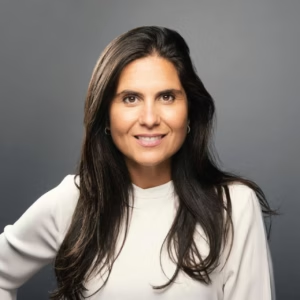
This was the central theme of an interactive session led by Lily Lapenna, Founder of MyBnk—the UK’s leading financial education organization—and CEO of GLEOW Group, where she has coached hundreds of senior executives globally.
What emerged was a powerful reframing of leadership communication in the social impact economy.

The Core Insight: Delivery Shapes Trust More Than Message
One of the strongest lessons from the session was deceptively simple:
In leadership communication, the message matters less than the way it is delivered.
.
A leadership experience focused on energy, connection, and momentum.
Apply / RSVP Here.

Participants explored how tone, structure, embodiment, and narrative coherence determine whether a message creates trust—or resistance. In high-stakes environments—fundraising, public engagement, boardrooms, or cross-sector collaboration—leaders are evaluated not only on clarity, but on presence under pressure.
This marks a departure from traditional leadership development, which has long over-indexed on content, credentials, and analytical rigor.

Why Experience-Based Learning Changes Leaders Faster
Rather than relying on lectures, the session emphasized experience-driven learning—using role-play, gamification, and embodied communication exercises. This approach reflects a growing consensus in leadership science: behavior changes faster through experience than instruction.
Key takeaways from the workshop included:
-
Experience creates memory; memory shapes behavior
-
Gamification lowers resistance and accelerates learning
-
Presence is a trainable skill, not a personality trait
-
Influence is built through congruence between voice, body, and intent
These insights resonate strongly with modern organizational needs, where leaders must communicate across cultures, disciplines, and power dynamics.

Executive Presence as a Global Leadership Skill
In the context of social innovation and global leadership, executive presence takes on even greater importance. Leaders must often translate complex social realities into compelling narratives for diverse stakeholders—investors, governments, communities, and teams.
What became clear during the Harvard Kennedy School session is that presence is no longer a “soft skill.”
It is a strategic capability.
.

.
As one theme repeatedly surfaced:
It is not enough to have impact.
You must be able to communicate impact—credibly, confidently, and humanly.

From Harvard Classrooms to the Frontlines of Change
This session exemplified a broader shift in global leadership development: the integration of academic insight with real-world application. Harvard Kennedy School’s emphasis on public leadership, social innovation, and experiential learning reflects the demands placed on today’s leaders operating in volatile, high-trust environments.
The result is a new leadership profile—one that combines intellectual rigor with emotional intelligence, narrative competence, and presence.
The Leadership Question That Matters Now
For executives, founders, and social innovators accelerating their careers and impact, the critical question is no longer:
“Do I have the right expertise?”
But rather:
If your expertise is strong—but your presence is weak—
how fast can your leadership really scale?
In the global leadership economy, presence is no longer optional.
It is the multiplier.
This article reflects leadership insights drawn from a Harvard Kennedy School session previously attended by the author. The analysis and commentary are newly written for NEWYORKBEX’s Global Leadership series.
This article reflects leadership insights inspired by a public session at Harvard Kennedy School. The analysis and interpretations are independently authored by NEWYORKBEX.
