


According to Gallup’s analysis “How Can Leaders Build Accountability and High Performance at Work?”, leaders and managers agree on where leadership most often falls short: creating accountability.
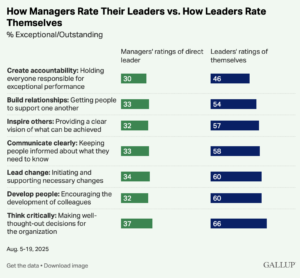
A 2025 Gallup survey ranks creating accountability lowest among seven leadership competencies that influence engagement and performance.
Fewer than half of leaders, 46%, rate themselves as exceptional or outstanding at holding everyone responsible for exceptional performance. Even fewer managers, 30%, rate their leaders the same way.
An individual problem, or a culture problem?
Leaders often see a lack of accountability as an individual issue, such as an employee missing deadlines. But Gallup argues that “weak individual accountability can reflect broader culture issues related to how work gets done within teams, across leadership levels and throughout the organization.”
Poor accountability can show up as a culture problem when:
- Leaders and teams have different expectations for performance and results.
- Managers are inconsistent in holding people accountable.
- Employees complete their work but don’t feel responsible for the outcome.
- Some teams have frequent performance conversations, while others rarely have them.
- The same operational and relationship problems keep recurring across the organization.
Six reasons accountability breaks down
Gallup identifies common causes:
- Unclear or misaligned expectations: Frontline teams ignore expectations that don’t match how the work actually gets done.
- Underdeveloped managers: Managers need more support to hold meaningful performance conversations.
- Inconsistent standards: When teams apply standards differently, accountability “can seem optional.”
- Correction instead of coaching: Leaders address performance only when something goes wrong.
- Ineffective recognition: Recognition doesn’t reinforce the behaviors that drive results.
- Disconnection from the work: When people aren’t doing work that fits their natural talents, their motivation and sense of personal responsibility can decline.
Accountability without micromanagement
Gallup draws a sharp line between accountability and control. “Micromanaged teams can focus too much on what the boss thinks,” the analysis notes, citing a 2020 Gallup finding that micromanagement “can create fear and paralysis rather than personal responsibility for producing outstanding work.” Accountable teams, by contrast, “work with greater autonomy and take ownership of their work with mission, customer needs and results in mind.”
The analysis also distinguishes accountability from blame: “Accountability focuses on responsibility for outcomes and what happens next.” Blame, by contrast, “focuses on assigning fault after something goes wrong without addressing the conditions that contributed to the problem.”
Why it matters
The link to engagement is strong. Gallup finds that managers who rate their leaders as exceptional or outstanding at creating accountability are three times as likely to be engaged as those who do not. Yet according to Gallup’s 2024 research, only 19% of employees strongly agree that their manager explains how the organization’s cultural values influence their work.
Gallup’s recommendation: set clear expectations, follow up “through frequent coaching conversations rather than waiting for problems to occur,” recognize the behaviors that produce excellent results, and connect each person’s strengths to their work.
The leadership lens
The most revealing line in Gallup’s analysis may be this one: micromanagement “can create fear and paralysis.” Many leaders respond to weak accountability by tightening control, and in doing so produce exactly the fear that kills ownership. Real accountability is not a pressure system. It is an energy system: clarity about what matters, a leader who stays in the conversation, and work that lets people use what they do best. Fear gets compliance. Ownership needs something else.
Source: Gallup, “How Can Leaders Build Accountability and High Performance at Work?” gallup.com
